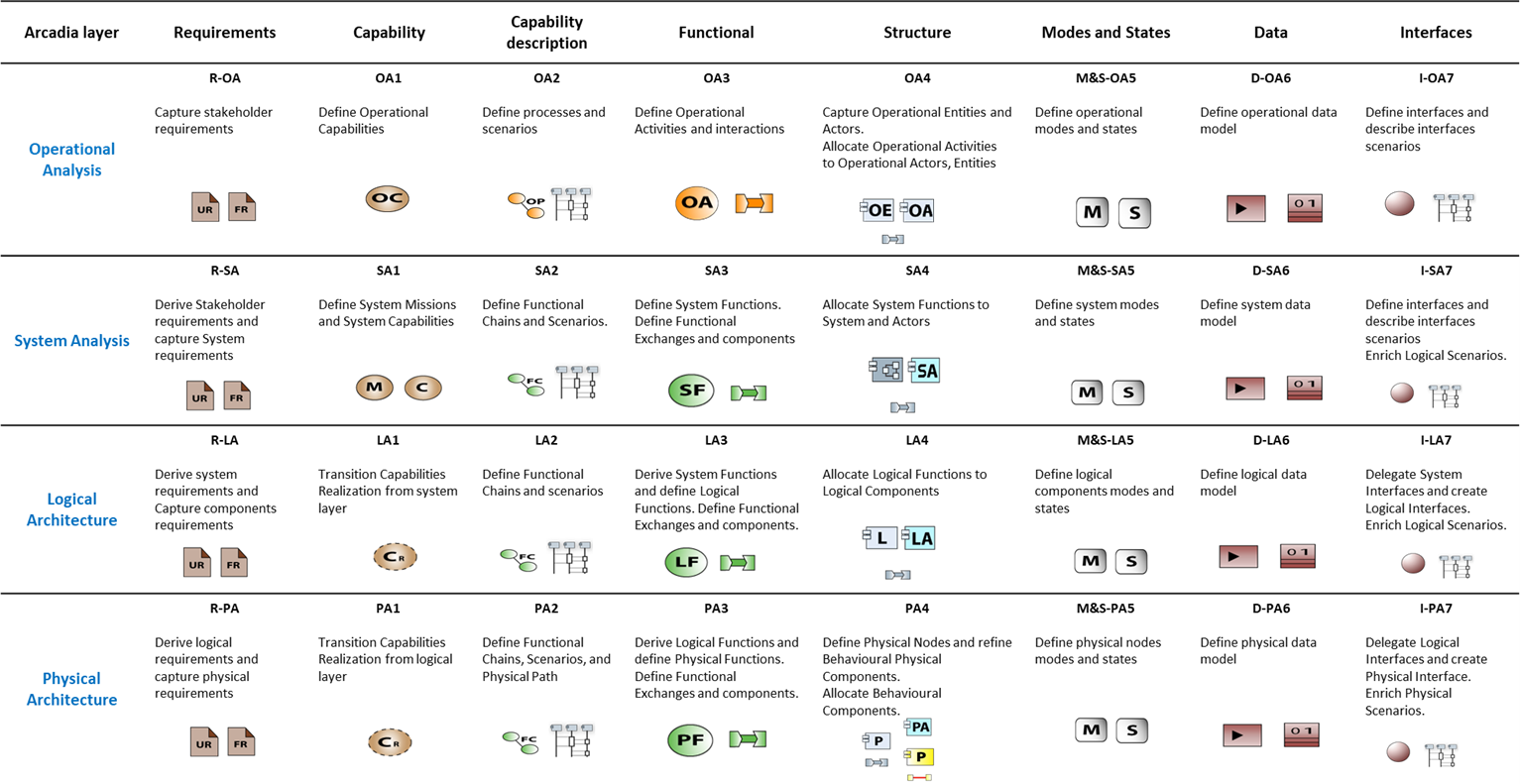
Arcadia is a tooled method devoted to systems & architecture engineering, supported by Capella modelling tool.
It describes the detailed reasoning to
It can be applied to complex systems, equipment, software or hardware architecture definition, especially those dealing with strong constraints to be reconciled (cost, performance, safety, security, reuse, consumption, weight…).
It is intended to be used by most stakeholders in system/product/software or hardware definition and IVVQ as their common engineering reference and collaboration support.
Arcadia stands for ARChitecture Analysis and Design Integrated Approach.
A series of online documents to dive into the principles and concepts of Arcadia:
Arcadia is a system engineering method based on the use of models, with a focus on the collaborative definition, evaluation and exploitation of its architecture.
This book describes the fundamentals of the method and its contribution to engineering issues such as requirements management, product line, system supervision, and integration, verification and validation (IVV). It provides a reference for the modeling language defined by Arcadia.
Jean-Luc Voirin, leader of the creation of the Arcadia method, along with some of the leaders on developing and deploying MBSE Arcadia & Capella practices in Thales. From right to left: Pierre Nowodzienski, Jean-Luc Voirin, Juan Navas, Stephane Bonnet, Frederic Maraux, Gerald Garcia, Philippe Fournies, Eric Lepicier.
Architecture as prime engineering driver
Arcadia, a model-based engineering method
Noticeable features of Arcadia
Definition of the Problem - Customer Operational Need Analysis
Formalization of system requirements - System Need Analysis
Development of System Architectural Design - Logical Architecture (Notional Solution)
Development of System Architecture - Physical Architecture
Formalize Components Requirements - Contracts for Development and IVVQ
Co-Engineering, Sub-Contracting and Multi-Level Engineering
Adaptation of Arcadia to Dedicated Domains, Contexts, Etc.
Equivalences and Differences between SysML and Arcadia/Capella
A standout feature of NBA 2K23 was the overhaul of the mode. Unlike previous years, this allowed players to travel back in time to start their franchise journey in different eras: The Magic vs. Bird Era (1980s) The Jordan Era (1990s) The Kobe Era (Early 2000s)
Key improvements from this era include:
: Added 2K Beats tracks from artists like Lil Pump and Jovanie, plus new WNBA jerseys in the "The W" mode 2K Newsroom The Goldberg Emulator Component The "Goldberg" suffix indicates that the release uses the Goldberg Steam Emulator , a tool created by developer Mr_Goldberg NBA 2K23 v20221202-Goldberg
The December 2, 2022 version caught the game at a high point in terms of balancing and gameplay refinement. A standout feature of NBA 2K23 was the overhaul of the mode
By using the , players are able to run the game flawlessly in a sandbox environment. This unlocks several distinct advantages for legacy players: By using the , players are able to
While builds featuring the Goldberg emulator are highly stable, they change how the game behaves regarding online networks:
The Goldberg Emulator replaces the official Steam API dynamic link library file ( steam_api64.dll ) with a modified, custom alternative. Instead of pinging the active Steam client or checking online servers for validation, this custom file tricks the game into believing it is running on a valid, authenticated Steam account in offline mode. Why Players Utilize the Emulator