 The EUREQA dataset
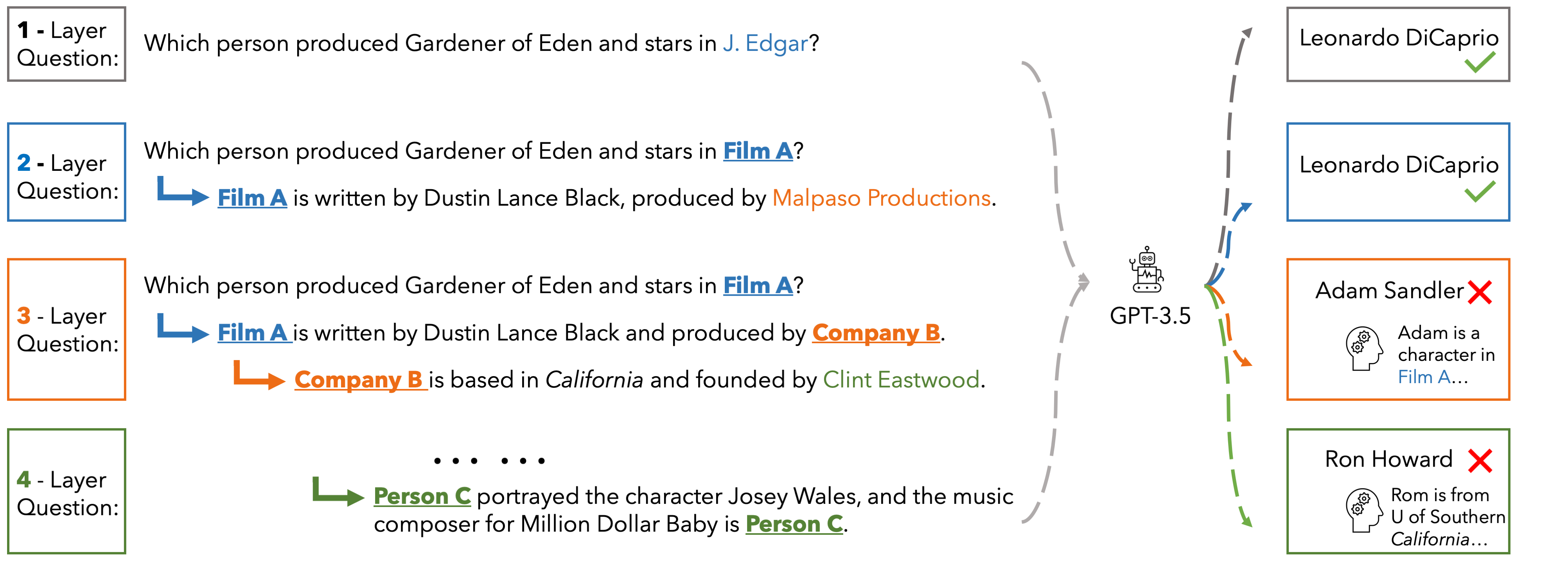
In EUREQA, every question is constructed through an implicit reasoning chain. The chain is constructed by parsing DBPedia. Each layer comprises three components: an entity, a fact about the entity, and a relation between the entity
and its counterpart from the next layer. The layers stack up to create chains with different depths of reasoning. We verbalize reasoning chains into natural sentences and anonymize the entity of each layer to create the question.
Questions can be solved layer by layer and each layer is guaranteed a unique answer. EUREQA is not a knowledge game: we adopt a knowledge filtering process that ensures that most LLMs have sufficient world knowledge to answer our questions.
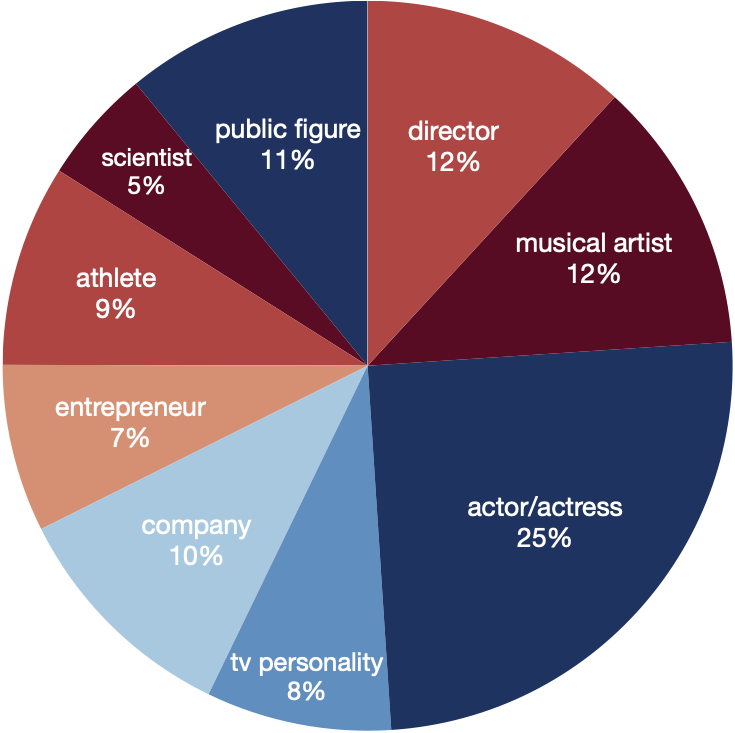
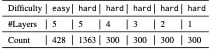
EUREQA comprises a total of 2,991 questions of different reasoning depths and difficulties. The entities encompass a broad spectrum of topics, effectively reducing any potential bias arising from specific entity categories.
These data are great for analyzing the reasoning processes of LLMs
: Advanced versions provide feedback on whether your inputs meet ACI standards for durability and exposure classes.
A professional-grade Excel template typically includes three primary sections: Input Data
Automating Concrete Mix Design with ACI 211.1 in Excel Concrete mix design is the process of finding the right proportions of cement, water, and aggregates to achieve specific strength, durability, and workability. Using an Excel sheet for this process, based on the standard, can significantly improve efficiency, reduce manual calculation errors, and ensure consistent quality across construction projects . Core Benefits of an Excel-Based Design
One of the most tedious manual tasks is interpolating values from the various ACI tables—for example, finding the exact water demand for a slump of 65mm when the table only provides values for 50mm and 75mm. An Excel sheet can be programmed with linear interpolation functions that instantly provide the precise value, a feature that alone is a compelling reason to use a spreadsheet.
Apply the TREND or FORECAST functions to interpolate values when inputs fall between standard table increments. Calculations and Batch Output Zone
 Analyses and discussion
: Advanced versions provide feedback on whether your inputs meet ACI standards for durability and exposure classes.
A professional-grade Excel template typically includes three primary sections: Input Data
Automating Concrete Mix Design with ACI 211.1 in Excel Concrete mix design is the process of finding the right proportions of cement, water, and aggregates to achieve specific strength, durability, and workability. Using an Excel sheet for this process, based on the standard, can significantly improve efficiency, reduce manual calculation errors, and ensure consistent quality across construction projects . Core Benefits of an Excel-Based Design
One of the most tedious manual tasks is interpolating values from the various ACI tables—for example, finding the exact water demand for a slump of 65mm when the table only provides values for 50mm and 75mm. An Excel sheet can be programmed with linear interpolation functions that instantly provide the precise value, a feature that alone is a compelling reason to use a spreadsheet.
Apply the TREND or FORECAST functions to interpolate values when inputs fall between standard table increments. Calculations and Batch Output Zone
This website is adapted from Nerfies, UniversalNER and LLaVA, licensed under a Creative Commons Attribution-ShareAlike 4.0 International License. We thank the LLaMA team for giving us access to their models.
Usage and License Notices: The data abd code is intended and licensed for research use only. They are also restricted to uses that follow the license agreement of LLaMA, ChatGPT, and the original dataset used in the benchmark. The dataset is CC BY NC 4.0 (allowing only non-commercial use) and models trained using the dataset should not be used outside of research purposes.