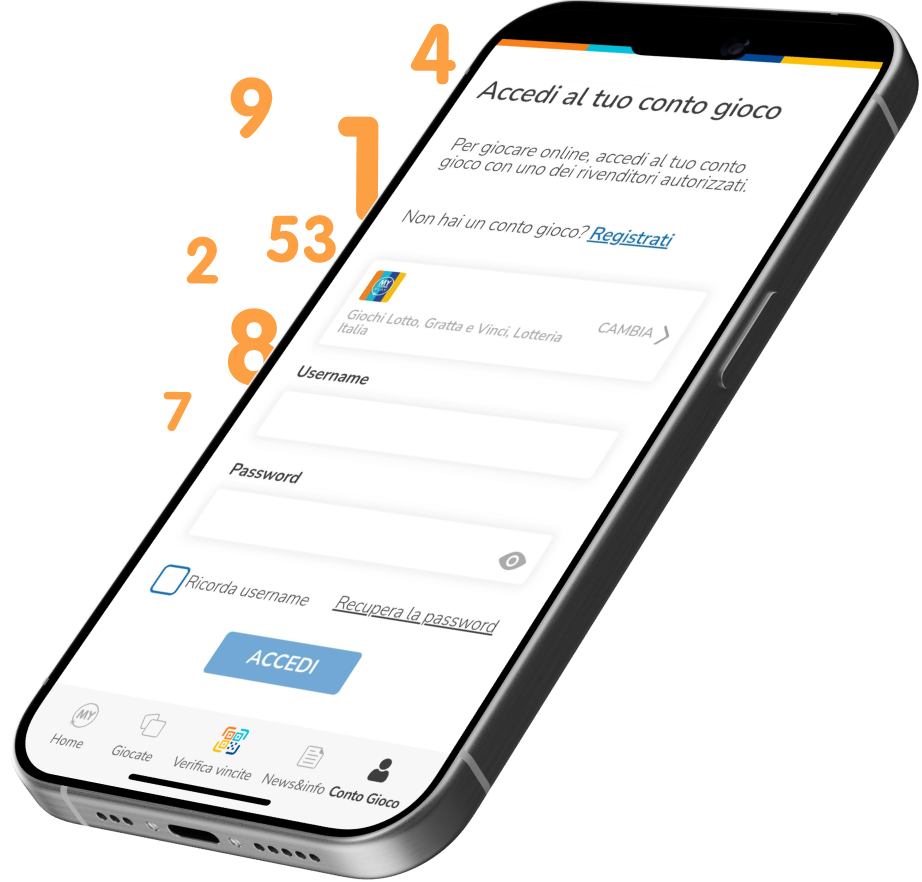
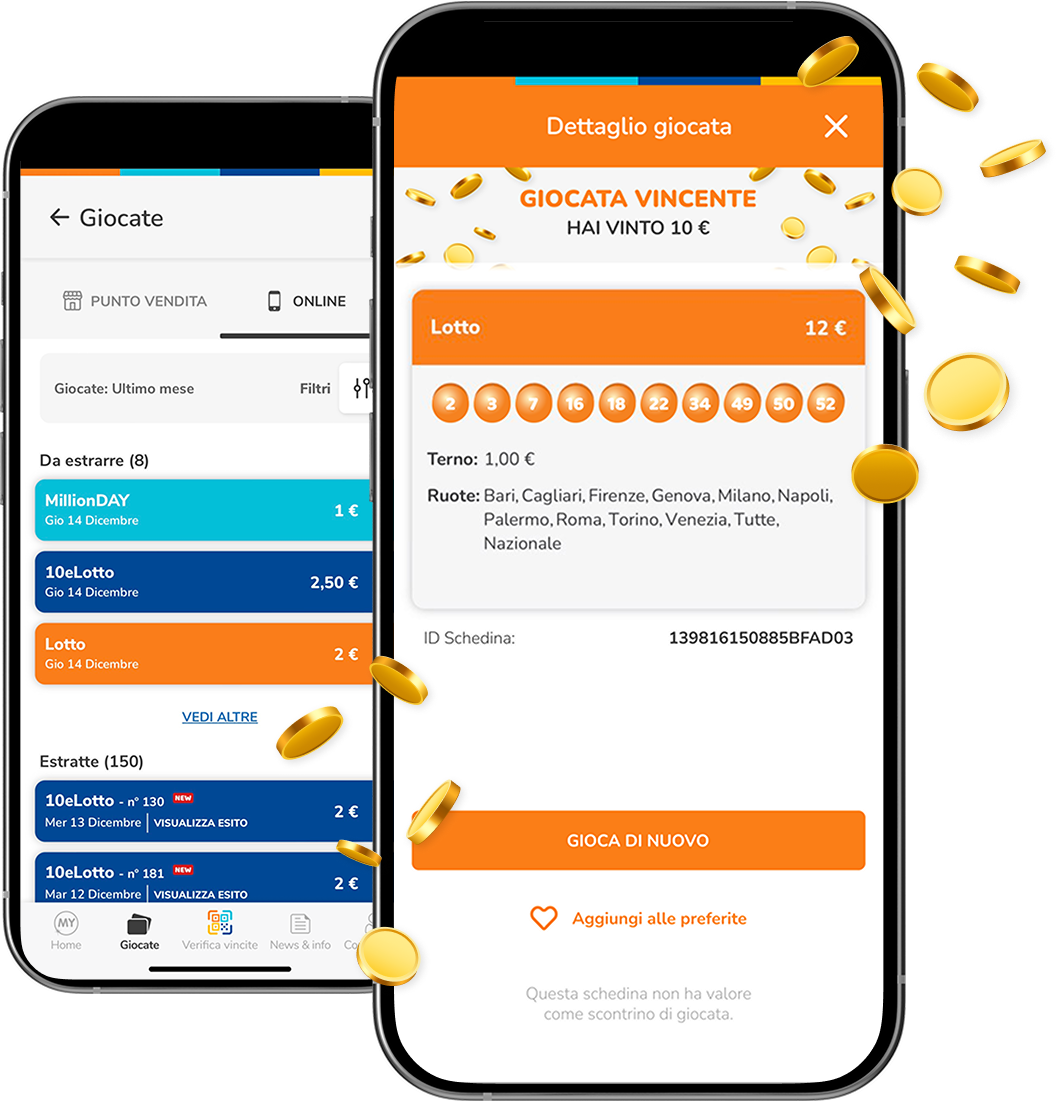
Con l’app ufficiale Lotto e Gratta e Vinci puoi verificare le
vincite, seguire le estrazioni in diretta e giocare on line
Scarica subito la nuova app!
Scarica subito la nuova app!
Inquadra il QR code oppure visita dal tuo smartphone il
sito
mylotteries.it
Inquadra il QR code con il tuo smartphone per aprire il sito
da mobile.
Inquadra il QR code con il tuo smartphone per aprire il sito
da mobile.
Come installare l'app
Come installare l'app
1Visita il sito
mylotteries.it
dal cellulare e premi il pulsante
SCARICA PER ANDROID
2Ti verrà chiesto di scaricare il file
MyLotteries.apk
premi il pulsante
SCARICA*
3Una volta scaricato il file premi il pulsante
APRI e infine
INSTALLA
*Se non hai mai scaricato un'app al di fuori del Play
Store vai su
IMPOSTAZIONI > SICUREZZA
del tuo smartphone e controlla che la voce
"Sorgenti sconosciute"
sia
ATTIVA
La tua esperienza di gioco in mobilità e in tutta sicurezza.
Con App My Lotteries puoi vivere la tua esperienza a
Lotto,
10eLotto,
MillionDay e
Gratta e Vinci
direttamente dal tuo smartphone dove e quando vuoi. Puoi
verificare se la tua giocata è vincente, compilare comodamente
la tua schedina in app e giocarla nel punto vendita, consultare
in qualsiasi momento gli ultimi numeri estratti nella sezione
archivio delle estrazioni e giocare online.
Con l’App My Lotteries puoi controllare se hai vinto semplicemente
inquadrando il biglietto Gratta e Vinci e lo scontrino del 10eLotto,
Lotto e MillionDAY nella sezione Verifica Vincite.
Free Shemales Smoking | Extra Quality
For allies within and outside the LGBTQ umbrella, the path forward is clear: learn the difference between sexual orientation and gender identity, honor the shared history, acknowledge the unique challenges, and fight fiercely for the most vulnerable among us. Because in the end, no one is free until everyone is free—and that includes the right to live, love, and simply be as one’s authentic self.
The transgender community and broader LGBTQ culture are defined by a rich history of resilience, evolving language, and a continuous push for legal and social recognition. While progress has been made, significant challenges regarding safety, healthcare, and equality remain. 🏳️⚧️ Understanding the Transgender Community
The LGBTQ+ rights movement is often visualized through a specific historical lens: the Stonewall Riots of 1969, led by drag queens and butch lesbians; the fight for marriage equality; the pink triangle reclaimed as a symbol of pride. Yet, within this broad coalition of sexual and gender minorities, the transgender community occupies a unique and often precarious position. To understand modern LGBTQ+ culture, one must look deeply at the transgender experience—not merely as a sub-category of “queerness,” but as a vital, challenging, and transformative force that has reshaped the movement’s philosophy, priorities, and very definition of identity. The relationship between the transgender community and the broader LGBTQ+ culture is a dynamic, sometimes turbulent story of solidarity, erasure, rebellion, and eventual emergence as the movement’s most visible frontier.
Furthermore, the rise of non-binary and genderfluid identities has pushed LGBTQ+ culture beyond a simple two-category system. The “T” in LGBTQ+ is no longer assumed to refer solely to a binary transition from male to female or female to male. Instead, it encompasses a rich spectrum: agender, bigender, genderqueer, and countless other identities that reject the very premise of a gender binary. This philosophical shift has led to practical cultural changes: the adoption of singular “they/them” pronouns, the creation of gender-neutral bathrooms and dress codes, and the questioning of gendered rituals within gay pride parades themselves (e.g., the division of “dykes on bikes” and “men’s” spaces).
For allies within and outside the LGBTQ umbrella, the path forward is clear: learn the difference between sexual orientation and gender identity, honor the shared history, acknowledge the unique challenges, and fight fiercely for the most vulnerable among us. Because in the end, no one is free until everyone is free—and that includes the right to live, love, and simply be as one’s authentic self.
The transgender community and broader LGBTQ culture are defined by a rich history of resilience, evolving language, and a continuous push for legal and social recognition. While progress has been made, significant challenges regarding safety, healthcare, and equality remain. 🏳️⚧️ Understanding the Transgender Community
The LGBTQ+ rights movement is often visualized through a specific historical lens: the Stonewall Riots of 1969, led by drag queens and butch lesbians; the fight for marriage equality; the pink triangle reclaimed as a symbol of pride. Yet, within this broad coalition of sexual and gender minorities, the transgender community occupies a unique and often precarious position. To understand modern LGBTQ+ culture, one must look deeply at the transgender experience—not merely as a sub-category of “queerness,” but as a vital, challenging, and transformative force that has reshaped the movement’s philosophy, priorities, and very definition of identity. The relationship between the transgender community and the broader LGBTQ+ culture is a dynamic, sometimes turbulent story of solidarity, erasure, rebellion, and eventual emergence as the movement’s most visible frontier.
Furthermore, the rise of non-binary and genderfluid identities has pushed LGBTQ+ culture beyond a simple two-category system. The “T” in LGBTQ+ is no longer assumed to refer solely to a binary transition from male to female or female to male. Instead, it encompasses a rich spectrum: agender, bigender, genderqueer, and countless other identities that reject the very premise of a gender binary. This philosophical shift has led to practical cultural changes: the adoption of singular “they/them” pronouns, the creation of gender-neutral bathrooms and dress codes, and the questioning of gendered rituals within gay pride parades themselves (e.g., the division of “dykes on bikes” and “men’s” spaces).